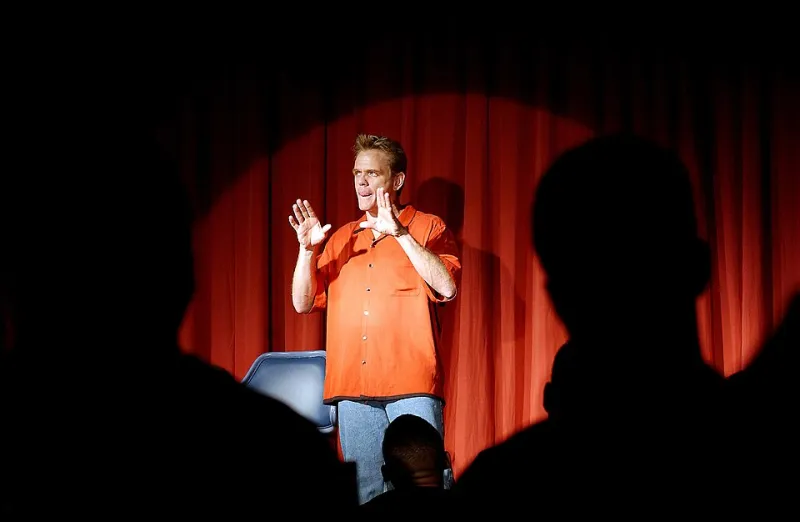
The Interval Is a Lie: Chester's Bladder-First Guide to Comedy Seating
Photo: The original uploader was Three Sixty at Wikimedia Commons., CC0, via Wikimedia Commons
There's a moment, roughly forty minutes into any Chester comedy night, when the laughter stops being the loudest thing in your head. It's replaced by a quieter, more insistent voice. It has no punchline. It just says: now.
You know the one. It arrives the instant you settle, the instant the compere announces three more acts, the instant you realise the interval is not a legal right but a rumour. Chester's comedy rooms — the snug back bars off Watergate Street, the function rooms above the pubs on the Rows, the pop-up nights a short trot from the Racecourse — were mostly built for standing, leaning and quietly nursing a half. Nobody designed them with the mid-set dash in mind. And yet here we are, every single week.
So consider this your briefing. Not a review of the bill, not a ranking of gags. A tactical document, drawn up in the drizzle of a November evening, for the most universal crisis in live comedy: needing the loo while a stranger holds a microphone and the room is on their side.
The Aisle Seat Is a Trap, and It Knows It
Everyone books the aisle thinking they've won. Legroom. Easy exit. A sense of options. What they've actually done is volunteer to be the show's unofficial second act.
Here's the maths. The aisle seat has the shortest route to the door, which means it also has the longest route through the comic's eyeline. Comedians are predators of movement. A rustle at the back is a gift; a full adult rising from the front is Christmas morning. You won't simply leave. You'll be introduced. Your pint will be commented on. Your excuse will be interrogated and improved upon by a person with a microphone and nothing to lose.
Front row, aisle side, is the worst seat in the house for exactly this reason. Second row aisle is only marginally safer — you still cross the beam of the stage light, but at least you can pretend you were always going. Third row back, wall side, is where the professionals sit. Watch them. They leave at the interval and return with drinks like people who have read the manual.
A Seat-by-Seat Threat Assessment
Ranked from invisible to 'you are now part of the set':
- The back-row wall seat. Practically a fire exit. You can leave, return and be forgotten inside ninety seconds. Downside: you can't see the comic's eyebrows, and eyebrows do half the work.
- The pillar-adjacent stool. Chester has no shortage of structural pillars, and every one of them is a small mercy. Step behind it and you briefly cease to exist. Use it. Bless it.
- The end of a booth. One person has to move, but booths are dark and forgiving. If your companion is a mate, they'll shuffle without a word. If it's a date, you've just stress-tested the relationship in public.
- The middle of a row. Now you're asking four strangers to stand up in the dark. The domino effect is audible. The comic will hear it. The comic will name it.
- Front row centre. This isn't a seat. It's a hostage situation with a drinks menu.
The Pint Is the Problem, Not the Solution
Every bladder catastrophe at a comedy gig begins with good intentions and a two-for-one offer. Let's be honest: the pre-show pint isn't negotiable. It's part of the ritual, part of the warm-up, part of why you agreed to leave the house on a wet Tuesday.
But timing is everything. A pint finished at 19:15 is a pint you'll be visiting at 20:45. A pint finished at 19:50 is a pint you'll be visiting during the headliner's best bit. The sweet spot is a drink that starts forty-five minutes out and ends with a deliberate, slightly mournful abandonment of the last inch. Yes, it feels like a small funeral. Do it anyway.
The same rule applies to the interval. The interval isn't a break; it's a stampede. Everyone in the building has the same idea at the same second, and Chester's older venues have roughly one and a half loos between them. If you wait for the compere to finish the sentence, you've already lost. Leave on the laugh, not on the applause. The laugh is cover fire.
The Exit Itself: Posture, Pace and the Apologetic Wave
When it's happening — and you'll know when it's happening — there is only one correct technique, and it isn't the crouch-run.
The crouch-run is a myth. It makes you larger, not smaller. It draws the eye, it looks guilty, and it takes three times as long. What you want is the opposite: stand up fully, at normal speed, as though you've simply remembered a prior engagement. Shoulders back. Face neutral. No eye contact with the stage, but no theatrical avoidance either. You aren't sneaking. You're a person who has decided.
If the comic clocks you — and they will — you've got two plays. The apologetic wave is the classic, and it works because it concedes the point gracefully. The alternative is the confident thumbs-up, which is riskier but occasionally earns a callback you'll be hearing about from your mates for a fortnight. Never explain. Explanations are content. 'Sorry, mate' is the entire script.
At the door, thank the staff member quietly and keep moving. Don't stop in the doorway to look back and assess the damage. The doorway is the brightest part of the room. You're now a silhouette with a story.
The Return Is Worse Than the Departure
Nobody warns you about this. Leaving is embarrassing; coming back is a judicial hearing.
Re-entering a comedy room means walking into a punchline's blast radius with the door still swinging. The crowd has rearranged itself in your absence, or so it feels. Your seat is somehow further away. Your pint is warm. Your companion is mid-laugh and cannot help you.
The answer is patience. Stand at the back for ninety seconds. Let a bit happen. Wait for the biggest laugh in the room, then move. Noise is camouflage. If you return during a quiet, confessional bit about somebody's dad, you will become the third character in it.
The Simple Truth
Chester's comedy nights are small, warm and gloriously badly designed for human biology. That's part of the charm. But charm is easier to enjoy when you aren't negotiating with your own kidneys.
So: book the wall seat. Pace the pint. Leave on the laugh. And if you do get caught in the beam of the stage light, hold your head up, wave like a minor royal, and remember the golden rule of the mid-set dash — you aren't interrupting the show. You're just the interval, arriving early.